Σελίδες

Thursday, January 24, 2013

Les Catacombes de Paris/Catacombs of Paris


The Catacombs of Paris or Catacombes de Paris are an underground ossuary in Paris, France. Located south of the former city gate (the "Barrière d'Enfer" at today's Place Denfert-Rochereau), the ossuary holds the remains of about six million people[1] and fills a renovated section of caverns and tunnels that are the remains of Paris's stone mines. Opened in the late 18th century, the underground cemetery became a tourist attraction on a small scale from the early 19th century, and has been open to the public on a regular basis from 1874. Following an incident of vandalism, they were closed to the public in September 2009 and reopened 19 December of the same year.[2]
The official name for the catacombs is l'Ossuaire Municipal. Although this cemetery covers only a small section of underground tunnels comprising "les carrières de Paris" ("the quarries of Paris"), Parisians today often refer to the entire tunnel network as "the catacombs".


Background: Paris cemeteries


View in the catacombs.
Since Roman times, Paris has buried its dead on the outskirts of the city, but habits changed with the rise of Christianity and its practice of burying its faithful in the consecrated ground under and around its churches, no matter their location. By the 10th century, many of Paris's parish cemeteries were well within city limits, and eventually some, because of their central location in dense urban growth, were unable to expand and became overcrowded. An attempt to remedy this situation came in the early 12th century with the opening of a central mass burial ground for those not wealthy enough to pay for a church burial. Depending on the St. Opportune church near Paris's central Les Halles district, this cemetery had its own Saints Innocents church and parish appellation by the end of the same century. Eventually, Paris's other churches adopted the technique of mass inhumation as well. Once an excavation in one section of the cemetery was full, it would be covered over and another opened. Residues resulting from the decaying of organic matter, a process often chemically accelerated with the use of lime, entered directly into the earth, creating a situation unacceptable for a city whose then-principal source of water was wells.
By the 17th century, the sanitary conditions around Saints Innocents had become unbearable. As it was one of Paris's most sought-after cemeteries and a large source of revenue for the parish and church, the clergy had continued burials there even when its grounds were filled to overflowing. By then, the cemetery was lined on all four sides with "charniers" reserved for the bones of the dead exhumed from mass graves that had "lain" long enough for all the flesh they contained to decompose. Once emptied, a mass sepulchre would be used again, but even then, the earth was already filled beyond saturation with decomposing human remains.
A series of ineffective decrees limiting the use of the cemetery did little to remedy the situation, and it wasn't until the late 18th century that it was decided to create three new large-scale suburban burial grounds on the outskirts of the city, and to condemn all existing parish cemeteries within city limits. The new cemeteries were created outside the central area of the capital, in the early 19th century: Montmartre Cemetery in the north, Père Lachaise Cemetery in the east, Passy Cemetery in the west. Later, Montparnasse Cemetery was added in the south.

Paris's former mines

The government had been searching for and consolidating long abandoned stone quarries in and around the capital since 1777, and it was the Police Lieutenant General overseeing the renovations, Alexandre Lenoir, who first had the idea to use empty underground tunnels on the outskirts of the capital to this end. His successor, Thiroux de Crosne, chose a place to the south of Paris's "porte d'Enfer" city gate (the place Denfert-Rochereau today), and the exhumation and transfer of all Paris's dead to the underground sepulture began in 1786, taking until 1788 to complete.[3]

Creation, decoration

From the eve of a consecration ceremony on the 7th April the same year, behind a procession of chanting priests, began a parade of black-covered bone-laden horse-drawn wagons that continued for years. In work overseen by the Inspector General of Quarries, Charles-Axel Guillaumot, the bones were deposited in a wide well dug in land bought from a property, "La maison de la Tombe Issoire" (near a house with the same name), and distributed throughout the underground caverns by workers below. Also deposited near the same house were crosses, urns and other necropolis memorabilia recovered from Paris's church graveyards.

Bone pile in Parisian Catacombs
The catacombs in their first years were mainly a bone repository, but Guillaumot's successor from 1810, Louis-Étienne Héricart de Thury, oversaw the renovations that would transform the underground caverns into a real and visitable sepulture on par with any mausoleum. In addition to directing the arrangement of skulls and femurs into the configuration seen in the catacombs today, he used those tombstones and cemetery decorations he could find (many had disappeared after the 1789 Revolution) to complement the walls of bones.

General description

The Catacombs entry is in the western pavilion of Paris's former Barrière d'Enfer city gate. After descending a narrow spiral stone stairwell of 19 meters to the darkness and silence broken only by the gurgling of a hidden aqueduct channeling local springs away from the area, and after passing through a long (about 1.5 km) and twisting hallway of mortared stone, visitors find themselves before a sculpture that existed from a time before this part of the mines became an ossuary, a model of France's Port-Mahon fortress created by a former Quarry Inspector. Soon after, they would find themselves before a stone portal, the ossuary entry, with the inscription Arrête! C'est ici l'empire de la Mort ('Stop! Here lies the Empire of Death").
Beyond begin the halls and caverns of walls of carefully arranged bones. Some of the arrangements are almost artistic in nature, such as a heart-shaped outline in one wall formed with skulls embedded in surrounding tibias; another is a round room whose central pillar is also a carefully created 'keg' bone arrangement. Along the way one would find other 'monuments' created in the years before catacomb renovations, such as a source-gathering fountain baptised "La Samaritaine" because of later-added engravings. There are also rusty gates blocking passages leading to other 'unvisitable' parts of the catacombs – many of these are either un-renovated or were too un-navigable for regular tours.
In a cavern just before the exit stairway leading to a building on the rue Dareau (former 'rue des Catacombes') above, one could see an example of the Quarry Inspection's work in the rest of Paris's underground caverns: its roof is two 11-metre high domes of naturally degraded, but reinforced, rock; the dates painted into the highest point of each bear witness to what year the work to the collapsing cavern ceiling was done, and whether it has degraded since. These "fontis" were the reason for a general panic in late-18th-century Paris, after several houses and roadways collapsed into previously unknown caverns below.

Other inhumations

Bodies of the dead from the riots in the Place de Grève, the Hôtel de Brienne, and Rue Meslée were put in the catacombs on 28 and 29 August 1788.
The tomb of the Val-de-Grâce hospital doorkeeper, Philibert Aspairt, lost in the catacombs in 1793 and found 11 years later, is located in the catacombs on the spot where his body was found.
The catacomb walls are covered in graffiti dating from the eighteenth century onwards. Victor Hugo used his knowledge about the tunnel system in Les Misérables. In 1871, communards killed a group of monarchists in one chamber. During World War II, Parisian members of the French Resistance used the tunnel system. Also during this period, German soldiers established an underground bunker in the catacombs below Lycée Montaigne, a high school in the 6th arrondissement

Building Disadvantages

Although the catacombs offered space to bury the dead, they presented disadvantages to building structures; because the catacombs are right under the Paris streets, large foundations cannot be built. For this reason, there are not many tall buildings in Paris.

 From: Wikipedia


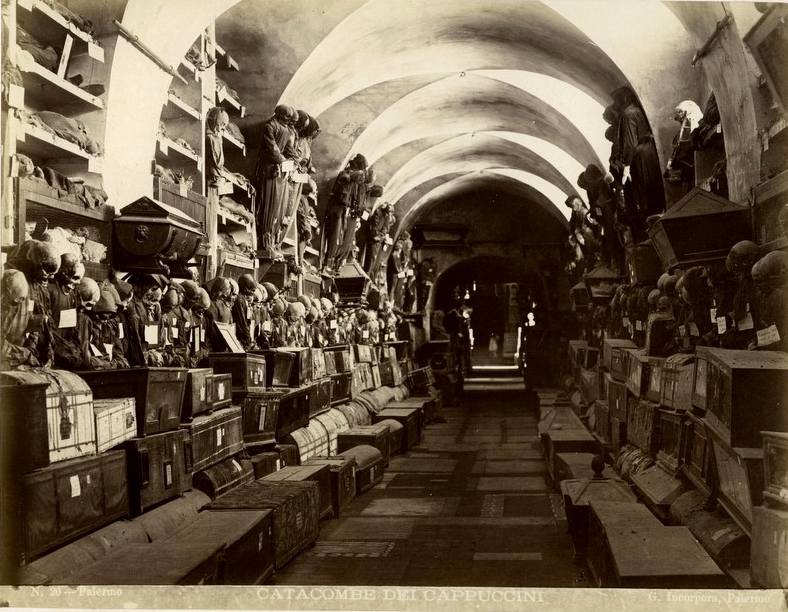
Capuchin Catacombs-Palermo, Italy

For visitors to Palermo who enjoy the macabre and/or bizarre, the Catacombe dei Cappuccini (Catacombs of the Capuchins or Capuchin Catacombs) are a must-see. Like most displays of human remains, a visit to the mummies can lead to reflection on the meaning of death. But it goes without saying that this "human library" of thousands of bodies is not for the faint-hearted or weak-stomached!

History

In 1599, Capuchin monks discovered that their catacombs contained a mysterious preservative that helped mummify the dead. As a result, more than 8,000 Sicilians from all walks of life chose to be buried here.
The corpses range in date from the late 1500s to 1920 and most were embalmed before their display. Giuseppe Tommasi, prince of Lampedusa and author of the famous Sicilian work The Leopard, was buried in the cemetery next to the catacombs in 1957.
In the 1940s, Allied bombs hit the monastery, destroying many of the mummies. The Capuchin Monastery (Convento dei Cappuccini) itself was rebuilt over the remains of the original medieval church in 1623 and was once again restored in the early 20th century.

What to See

Visitors can wander through the catacombs' dank corridors among the mummified bodies. The halls are divided into categories that include: Men, Women, Virgins, Children, Priests, Monks, and Professors (including the famous painter Velasquez).
The corpses are dressed in splendid clothes, now somewhat decayed, and occupy their own individual niches according to their social status. Many of the deceased wrote wills that specified the clothes in which to bury them, and some even asked to have their clothes changed over a period of time.
Many corpses are still remarkably preserved and some give the impression of enjoying a joke with their deceased friends. Others are not in such good shape, with horribly contorted, creepy faces and missing parts like jaws and hands.
The last corpse to be buried here was that of 2-year-old Rosalia Lombaro, who died in 1920. She is so well-preserved, she has been nicknamed "Sleeping Beauty."


Tuesday, January 22, 2013

Screw Revision

Πάρε μια σελίδα από το βιβλίο του σχολείου στο οποίο βαριέσαι το θανατά. Είναι γεμάτο ζωγραφιές, μουντζούρα κτλ  από μολύβι, στυλό και μαρκαδοράκι. Αυτή η σελίδα είναι η ζωή κάποιου που έχει περάσει δύσκολα και θέλει να κάνει ένα καινούριο ξεκίνημα στη ζωή. Η ζωή του είναι κυριολεκτικά στα χέρια σου. Πρόσεχε όμως, γιατί διαθέτεις μόνο μια σβήστρα και μπλάνκο. Ότι έχεις κάνει με μολύβι σβήνεται εύκολα και δεν αφήνει σχεδόν τίποτα, και συμβολίζουν κυρίως μικροδυσκολίες της ζωής του, όπως ανεκπλήρωτοι έρωτες, αποτυχία σε εξετάσεις/συνεντεύξεις για δουλειά κτλ. Ότι ζωγραφιά και μουντζούρα έχεις κάνει με στυλό είναι ότι πραγματικά κακό έχει του έχει συμβεί(πχ θάνατος αγαπημένου προσώπου κτλ) και φεύγει δύσκολα. Αλλά με τη μπλε πλευρά της σβήστρας, θα κουραστείς, θα σκίσεις λίγο το χαρτί, αλλά στο τέλος θα σβήσει, αφήνοντας μερικά υπολείμματα. Αλλά καθετί που βλέπεις με μαρκαδοράκι δε φεύγει με τη σβήστρα. Μένει για πάντα. Ακόμα και να το καλύψεις με μπλάνκο, πάλι θα υπάρχει από κάτω. Άσε που το μπλάνκο παίζει να λερώσει όλη τη σελίδα. Αυτά αποτελούνται κυρίως από δυσάρεστες εμπειρίες που έχουν διαμορφώσει το χαρακτήρα του, και δεν αλλάζουν, ακόμα κι αν προσπαθήσεις να τα καλύψεις. Ακόμα κι αν θες να ξεφορτωθείς τη μουντζούρα, τι θα κάνεις; Θα σκίσεις όλη τη σελίδα, σκοτώνοντας τον άνθρωπο για κάτι που δεν έχει πραγματικά σημασία;

Vcay


You’re Bored? That’s So AWESOME.

So…I saw your tweet.
You’re “bored”?

Bored.

…

WOW!

I am…absolutely floored. Hopelessly lost in admiration!
You are everything I aspire to be.
Oh. Hold on.
…..
Back. I had to go and check what “bored” meant, just in case the definition had changed in recently months, but no! It’s the same! In essence, you’re saying you have run out of things to do that are worthy of interest. Which is just an incredible place to be.

HOW YOU MUST HAVE LIVED.

I mean, by being bored, you must have…
  •  Eagerly delved into everything Stanford, Harvard and Yale are offering up on iTunes, entirely for free – or lost your mind wandering around Coursera, which aggregates courses from some of the most famous universities in the world…
  • …before testing yourself on the basics – all the basics – with Memrise.
  • …and then did the same with Chez Pim‘s output  - with enormous emphasis on the Pad Thai.
  • Backed up every single photo and critical document you own…
  • …and then did it again, elsewhere, because you never know when the badsectorpocalypse will strike…
  • …and even went as far as protecting all your precious bookmarks & settings on your favourite apps by going portable and sending a backup a copy to your USB or cloud drive?
  • Packed a bag, walked out your front door, caught a bus, caught another bus, caught yet another bus, and kept going until you ended up somewhere incredible? Because yes, it’s possible.
  • Read all The Morning News, then all of World Hum, then every scrap of archived material from Brain Pickings, rounding things off with the Paris Review. (Well done. You’ve read some of – and read about some of – the best writing on the Internet. Admirable way to spend a couple of decades. I applaud your dedication).
  • Read Lord Of The Rings yet again, except following the route in Barbara Strachey’s Journeys of Frodo (which can be previewed here because someone’s scanned them, but really, the book is a toe-wiggling joy – but you know that, having bought it, right?).
  • …and followed it up with a substantial dollop of TED-watching.
  • Grasped the fundamentals of the 6,000+ living languages of the world.
  • …and then somehow, against staggering odds, managing to fight your way through all 50 of these.
  • Read this trilogy, while following  the real history of Newton, Liebnitz, Hooke, Louis XIV, William II and all of Stephenson’s “characters” in a real history-of-science book (say, this one), and pinpoint exactly where Neal Stephenson has stuck to the facts and where he has taken wild, anachronistic flights of fancy.
  • …and then written at least as many fiction and non-fiction books as Isaac Asimov.
  • Sat outside and listened to the world – the birds, the weather and the bustle of humanity, the creak of your chair, the sound of your own breathing – until everything held absolutely zero novelty or interest for you. Been there? Done that? WOW.
  • Learned to recite and draw the RCA Animates from memory.
  • Addressed every lingering guilty regret, until you were satisfied you’d done absolutely everything you could to make amends, no matter how belatedly.
  • And finally (because it’s important to have a sense of proportion here) – you’ve followed every single link in every single issue of Zunguzungu‘s Sunday Reading series.
I mean, there’s other stuff – but let’s face it, doing these things really ate up your free time. You’re allowed a little slack!
And I don’t want to sound unreasonable, of course. Or bitchy.
Anyway, I’ll let you get back to being bored.
Because you, my friend, deserve it.
Image: Shermeee.